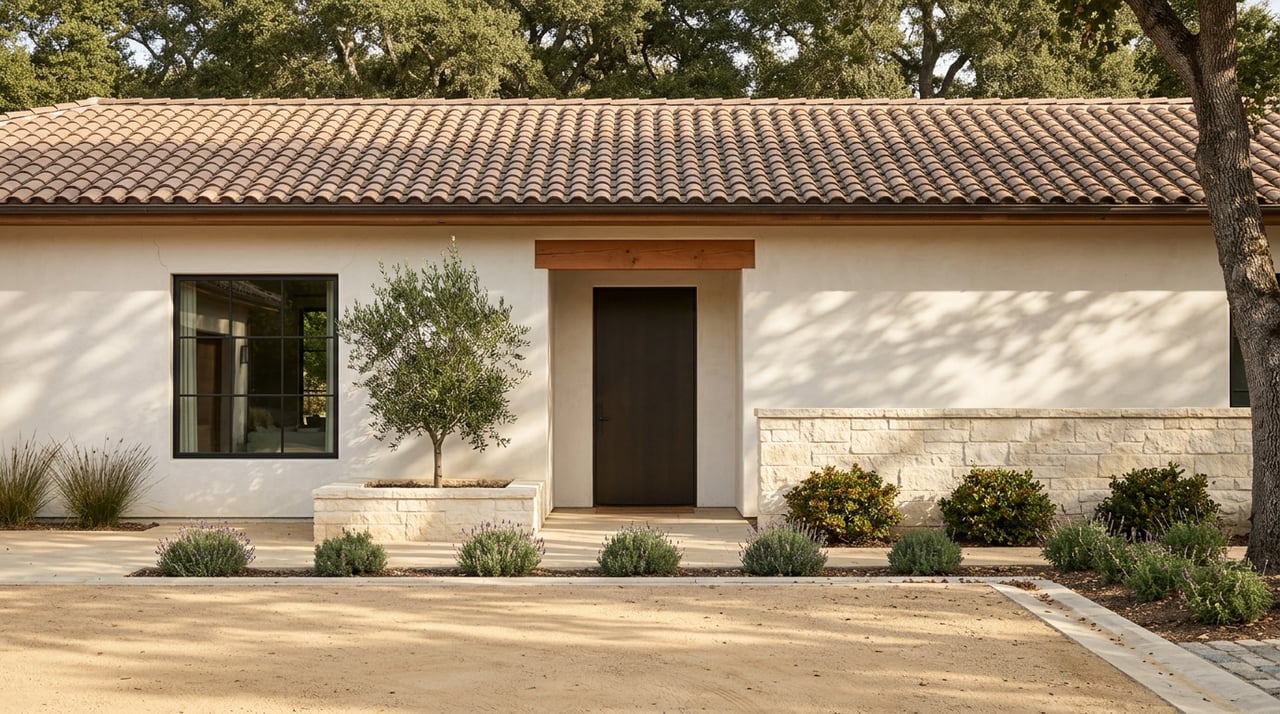
What Hopland Vineyard Buyers Should Model in 2026
July 16, 2026
July 16, 2026
Drive north on Highway 101 from Cloverdale through Hopland this summer and two things are visible from the same stretch of road. The first is bare dirt where Cabernet and Zinfandel stood last October. The second, four miles up University Road, is a demonstration vineyard at the UC Hopland Research and Extension Center where autonomous robots are running vine rows at night. Both facts are already priced into a small number of transactions. Neither is priced into the average list.
That gap is the story for anyone underwriting a Hopland-area vineyard parcel in 2026. The headline dollar-per-acre number you see on the aggregators is a lagging indicator of a market that has been repricing quietly since last harvest, and the buyer who treats it as the starting point of an offer is negotiating against a version of Mendocino that no longer exists.
Start with a single transaction. The Whaler Vineyard on Old River Road in Ukiah, a 34-acre estate, listed at $3.495 million in 2022 and closed at $1.685 million. That is not a distressed outlier. It is the shape of the curve.
North Coast removal totals now run Napa 3,117 acres, Sonoma 2,711, Mendocino 832, and Lake 777, and Mendocino's share is concentrated around Ukiah and Hopland where the county's identity as wine country is most visible. The county number reads small next to Napa's until you remember Mendocino's total planted footprint is a fraction of Napa's, which is why the effect on this specific stretch of Highway 101 is disproportionate. The 2025 California crush came in at 2.6 million tons, the lightest since 1999, and Rob McMillan's Silicon Valley Bank report sees 2027 to 2028 as a bumpy bottom, with recovery slow.
Two things follow. Contracts written against 2022 tonnage assumptions are being renegotiated or not renewed. And the parcels most likely to trade in 2026 and 2027 are the ones where the seller has already accepted that the next owner will replant, repurpose, or both.
The regulatory backdrop matters here because it is new, local, and quantified.
AB 732, effective January 1, 2026, gives county agricultural commissioners leverage over pest-ridden nuisance blocks, with penalties that start at $500 per acre and rise to $1,000 if owners do not act within 45 days. That is a small number to a hedge fund and a real number to a family grower carrying a neglected 40-acre block through a soft market.
What that means at the negotiating table:
Sellers who understand the statute will price around it. Sellers who do not will discover it during diligence, which is usually where the second round of price discussion happens anyway.
Four miles up University Road from downtown Hopland, the UC Research and Extension Center is celebrating its 75th year in 2026 as a landscape-scale living laboratory in southern Mendocino County's premium wine growing region. On June 30, the station ran a UC ANR Connect field day that is worth understanding in detail, because the equipment on display changes which parcels around Hopland are farmable at scale and which are not.
The free field day, hosted by UC ANR Innovate, brought eight agricultural technology companies to demonstrate their creations to growers, and the morning capped UC ANR Connect, a program UC ANR Innovate runs with Farmhand Ventures to get young ag tech companies field-ready. The lineup is the useful part.
Saga Robotics showed Thorvald, an autonomous robot that works vine rows at night, dosing grapevines with ultraviolet light to control powdery mildew, without chemicals and without disrupting daytime fieldwork. Caine Thompson, the company's U.S. general manager, told the crowd that growers are running out of chemistry and that there are "fewer and fewer options to control powdery mildew, botrytis and downy" mildew, especially close to harvest. Ag-Bee flew a spray drone across rows too steep for a tractor. Phytech, a sensing and decision-support platform, pairs in-field sensors on soil, vines and irrigation lines with analytics. Agtonomy is automation software built into equipment at the factory, letting farmers run repetitive jobs like mowing, spraying and weeding with less labor.
The point is not that any single buyer will deploy all four. The point is that the set of parcels that used to be uneconomic to farm because of slope, mildew pressure, or labor cost has quietly widened. A hillside block that penciled as removal-only in 2023 may pencil as farm-through in 2026 with the right service contract and a neighbor willing to share equipment.
Old underwriting of a Hopland-area vineyard parcel started with planted acres, applied a district grape price, netted farming cost, and capitalized the result. That model is still the right shape. Its inputs have changed.
| Input | Pre-2026 practice | 2026 practice |
|---|---|---|
| Grape price | District average, prior year | Actual current contract or none, with a two-year re-contracting scenario |
| Farming cost | Historical per-acre | Segregated by conventional, tech-enabled, and no-farm scenarios |
| Block condition | Visual inspection | Visual plus AB 732 exposure estimate at $500 to $1,000 per acre |
| Replant reserve | Optional | Line item on any block older than 25 years or off contract |
| Change-of-use option | Rarely modeled | Sheep, oak, or rangeland scenario per HREC's own working model |
That last row is the one buyers most often miss. Diverse research projects at Hopland Station, 15 to 20 of them in any given year, focus on finding practical solutions to issues facing northern California including rangeland management, viticultural systems, oak conservation, soil ecology, and livestock use and management. The station runs wine grapes alongside cattle and sheep on the same 5,300 acres because that mix is what the land supports, not because of nostalgia. Private buyers who model their acquisition the same way tend to make better decisions than those who assume a parcel must remain what it was.
Averages hide the parcels that are still worth chasing on their original terms.
Mendocino grower Lorenzo Pacini views the Largo area, the bench east of the Russian River, the way many view Rutherford or Oakville, saying it just produces great Cabernet, the best in Mendocino County in his opinion. That is a grower's opinion, not a comp. It matters anyway, because in a county where 832 acres have already come out and more may follow, the parcels that hold their identity are the ones where the fruit still has a specific buyer at a specific quality tier. Cabernet blocks on the Largo bench, Sauvignon Blanc in the right microclimate, small-lot Pinot in the cooler sites all deserve to be modeled separately from the surrounding average.
The practical rule for a buyer walking Hopland-area listings this summer is that district-level statistics tell you almost nothing about the parcel in front of you. The removals, the contract book, and the physical block condition all matter more than the headline.
For an exchange buyer under a 45-day identification clock, the useful additions to a 2026 diligence list are narrow:
None of that changes what a beautiful Hopland-area estate feels like when you drive up to it. It changes what the number at the bottom of the offer should be.
The buyers doing well in this market are the ones treating 2026 as a repricing year rather than a discount sale. The comps that closed in the last twelve months already reflect the removal wave. The comps that will close in the next twelve will reflect the technology on display at Hopland Station. The average of the two is not a market. It is a snapshot of a transition.
Contact Erik Terreri for a parcel-specific analysis that models contracts, replant reserves, AB 732 exposure, and change-of-use scenarios against your 1031 timeline. The right offer on a Hopland vineyard in 2026 is the one built on the parcel in front of you, not the district average behind it.


Whether buying or selling, trusted guidance ensures a seamless journey. Every detail is handled with care, turning real estate goals into achievements while providing clarity, confidence, and peace of mind throughout the process.