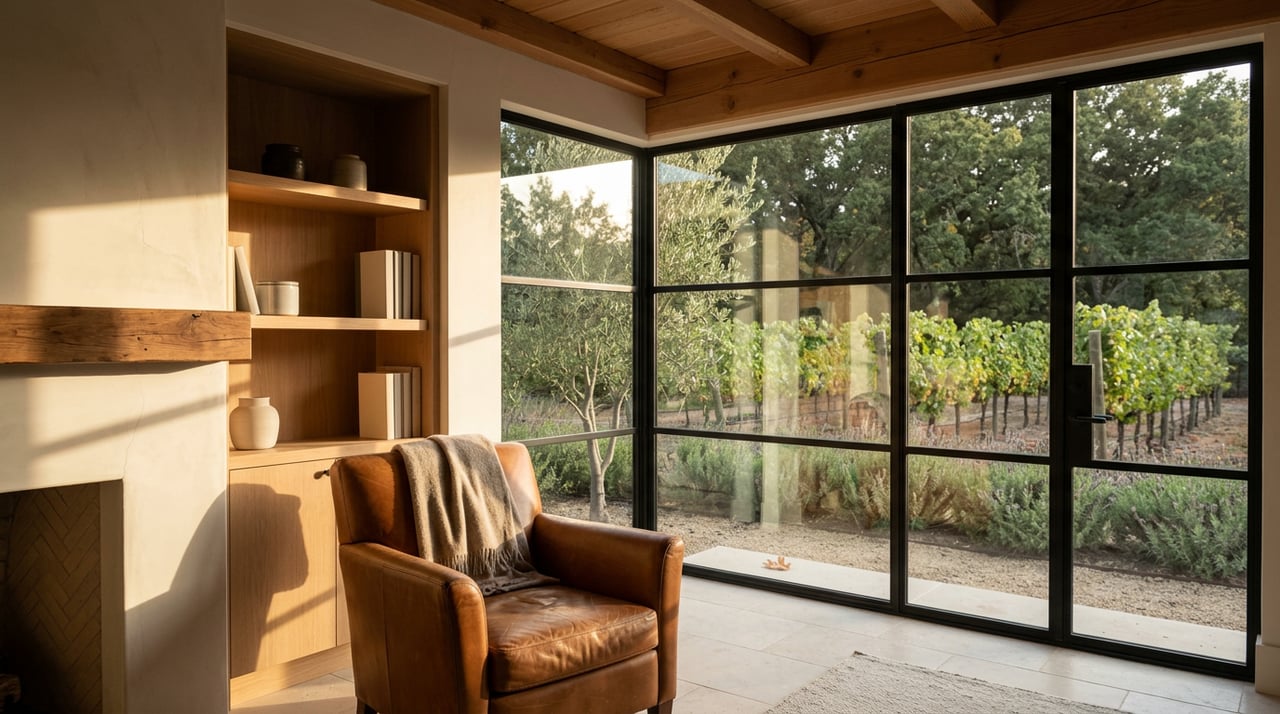
The Nine-Year Clock Hiding Inside Every Asti Vineyard Contract
August 20, 2026
August 20, 2026
Grape prices have been sliding across Sonoma County for most of 2026, and after several years of oversupply that pushed growers to mothball acreage and pull vines outright, a lot of landowners around Asti are asking the same question: is this the year to change what this ground is used for? The instinct makes sense. What most owners do not realize until they are already in escrow is that the answer has almost nothing to do with grape prices and almost everything to do with a piece of paper filed with Sonoma County that runs on its own calendar, one that does not care whether Cabernet is up or down this vintage.
That paper is a Williamson Act contract, formally the California Land Conservation Act of 1965, and if a parcel near Asti has one recorded against it, that contract, not the market, sets the pace for how fast a seller can actually change course.
A Williamson Act contract is a deal between a landowner and Sonoma County: keep the land in agricultural or open-space use for a rolling term, and the Assessor taxes it on farm income rather than market value. The trade only works one direction once it is signed. The contract is binding on all subsequent property owners, which means a buyer of Asti-area vineyard land does not get to negotiate the restriction away at closing. They inherit it, along with whatever tax benefit and land-use limits came with it.
For a working vineyard, that mostly means the contract does not get in the way, since farming is exactly what it is designed to protect. The friction shows up when an owner wants to do something the contract was written to prevent: subdivide, build non-agricultural structures, or convert acreage to a use that is not farming or open space. Permit Sonoma, the county department that administers these contracts, will not process a permit for new construction on restricted land until the applicant shows the proposed use is compatible with the existing contract.
Not every parcel is enrolled the same way, and the type on file changes how much flexibility an owner has.
| Type I (Prime Agricultural) | Type II (Non-Prime / Open Space) | |
|---|---|---|
| Minimum parcel size | 10 acres | 40 acres |
| Crop requirement | At least 50% planted in a permanent crop such as grapes | Grazing or open-space use, no permanent-crop minimum |
| Typical use around Asti | Planted vineyard blocks | Hillside acreage, unplanted ground, grazing land |
| Term structure | 10-year, automatically renews annually | 10-year, automatically renews annually |
Sonoma County also offers a Farmland Security Zone contract, a stricter version with a 20-year automatically renewing term in exchange for a larger tax reduction. Either way, the county generally wants a minimum of 100 contiguous acres to establish a new agricultural preserve in the first place, which can span multiple parcels under one owner or a group of adjoining owners.
Here is the part that catches sellers off guard. A Williamson Act contract does not simply expire when an owner decides they are done with it. To get out, the landowner (or the county, in certain enforcement situations) has to file a Notice of Non-Renewal. Once that notice is recorded, the existing contract terms stay in force for a nine-year phase-out period, during which property taxes climb gradually each year until they reach the unrestricted, market-based assessment. Only at the end of that window does the land become fully unencumbered.
There is a narrower version of this that hits smaller or oddly configured parcels harder. If a legal parcel does not meet the acreage minimums for its contract type, the county can classify it as "substandard" and serve its own Notice of Non-Renewal, starting that same nine-year clock without the owner asking for it. An owner served with one of these has the right to protest, but the window is tight, and protesting before the county's stated deadline only buys a few more years of tax benefit, not an exit from the phase-out itself.
The practical read for anyone weighing a change of use on Asti-area acreage in 2026: if the parcel has a Williamson Act contract and you file non-renewal this year in response to today's grape prices, you are still farming under the old rules, and paying the old, lower taxes, well into the next decade. The contract clock and the crop cycle simply do not move at the same speed, and pricing your exit strategy off this year's harvest numbers misreads how long the paperwork actually takes to unwind.
For 1031 buyers and other investor-grade purchasers, a Williamson Act contract is not a deal-breaker so much as a due-diligence item that has to be resolved before the closing date is real. Expect a competent buyer's team to request:
Sellers who assemble this file before listing, rather than scrambling once an offer arrives, move through escrow with far fewer surprises. State law also carries a real penalty for skipping the paperwork trail: new structures or expansions on a substandard parcel that is out of compliance can draw a fine equal to 25% of the land's unrestricted value.
Asti's most instructive real estate story is not a listing, it is a corporate sale. The Asti Winery, founded in 1881 by Italian immigrant Andrea Sbarboro and known for decades as Italian Swiss Colony, sat on 535 acres in the northern end of Alexander Valley, with 275 acres planted to vineyard. When Treasury Wine Estates put the property up for sale in March 2015, one of the features drawing serious interest was its senior water rights, dating back to 1914. E. & J. Gallo agreed to buy the winery and its Souverain brand that July, and the deal closed at the end of the month. Planted vineyard in Alexander Valley was trading in the range of $80,000 to $95,000 per acre at the time, which put the underlying land value at roughly $25 million even before the winery facility and permits were factored in. Treasury, for its part, booked a $7.5 million loss on the sale, a reminder that even a historic, well-watered property does not sell above the market it is actually in.
That deal moved quickly because Gallo was a cash buyer acquiring an operating business, brand, and permit, not a smaller owner untangling a Williamson Act contract from a family parcel. The contrast is the point: scale and water rights can make a deal move fast, but the legal mechanics still apply, and a smaller Asti-area seller without Gallo's resources feels the nine-year clock far more directly.
The backdrop this year is a lighter, earlier harvest than usual. A March heat wave triggered early bud break across North Coast vineyards, and the wet, windy weather that followed disrupted pollination, leaving many clusters sparse in a condition growers call shatter. The result, according to reporting from the Press Democrat in July 2026, is a smaller crop that could help ease years of oversupply that had already forced growers to mothball acreage and pull vines. Grape prices had been sliding into that harvest too, with Cabernet Sauvignon leading declines reported in a March 2026 review of Sonoma crush data.
None of that changes the Williamson Act timeline. A lighter 2026 harvest might improve grower economics next year or the year after, but it does not shorten a nine-year non-renewal period that is already running, and it does not retroactively speed up a phase-out an owner has not yet filed. For anyone holding Williamson Act land near Asti and reading this year's crop numbers as a signal to act, the more useful question is not what the harvest looks like this fall, but what year the contract clock actually started, and how many of those nine years are already behind you.
Does a Williamson Act contract transfer automatically when vineyard land is sold? Yes. The contract runs with the land and binds every subsequent owner, so a buyer takes on both the tax benefit and the use restrictions at closing.
Can an owner cancel a Williamson Act contract immediately instead of waiting through non-renewal? Cancellation exists as a separate, discretionary path, but it requires county approval, is not guaranteed, and typically costs more than simply filing non-renewal and waiting out the phase-out.
Does pulling vines on Williamson Act land violate the contract? Not by itself. The contract requires the land stay in a qualifying agricultural or open-space use, and the county reviews plantings periodically, so any plan to leave acreage fallow or repurpose it should be checked against the specific contract terms before work begins.
If you are weighing a sale of Williamson Act vineyard land near Asti, or trying to figure out how a 1031 timeline lines up with a non-renewal already in progress, Erik Terreri can walk through the specific contract on your parcel and what it means for your closing date.





Whether buying or selling, trusted guidance ensures a seamless journey. Every detail is handled with care, turning real estate goals into achievements while providing clarity, confidence, and peace of mind throughout the process.